Advanced IoT Solutions Built for Enterprise Scale and Trust Ops
Enterprise leaders no longer ask whether they need IoT Solutions. They ask whether their infrastructure can handle them at scale.
What once began as pilot programs with connected sensors has now evolved into mission-critical ecosystems that drive production lines, logistics networks, healthcare systems, and smart infrastructure. The shift is undeniable. However, scale without trust is a liability. And trust without architecture is fragile.
This is where enterprise-grade IoT separates itself from basic deployments. It is engineered, secured, governed, and strategically aligned with business goals from day one.
Why Basic IoT Fails at Enterprise Scale
Let’s be direct. Most IoT initiatives fail not because of technology but because of poor planning.
Organizations often deploy devices quickly, integrate them loosely, and postpone security decisions. Initially, everything works. Then comes expansion.
More devices. More endpoints. More data. More risk.
Suddenly:
- Data silos prevent actionable insights
- Security gaps widen attack surfaces
- Device management becomes chaotic
- Compliance requirements create friction
Without structured IoT consulting and architectural clarity, scaling becomes operationally expensive and risky.
Enterprise environments demand reliability. They demand governance. They demand control.
Anything less is a ticking liability.
What Defines Enterprise-Grade IoT Solutions
Not all IoT Solutions are built equally. Enterprise systems operate under higher expectations and tighter scrutiny.
1. Scalable Architecture
Enterprise IoT must support thousands, sometimes millions, of devices without performance degradation. Cloud-native platforms combined with modular design allow flexible growth while maintaining stability.
2. Secure Device Lifecycle Management
From provisioning to decommissioning, every device must be authenticated, monitored, and updated. This is where Internet of Things consulting becomes critical. A structured lifecycle prevents security drift and operational gaps.
3. Real-Time Data Intelligence
Data without action is noise. Enterprise IoT platforms integrate advanced analytics and edge processing to generate real-time decisions at the source.
4. Interoperability Across Systems
Modern enterprises operate hybrid ecosystems. ERP systems, CRM platforms, AI models, and analytics dashboards must communicate seamlessly. A consultant IoT strategy ensures integration across legacy and modern infrastructure.
The Strategic Power of IoT Consulting Services
Here’s where most businesses miscalculate. They invest in hardware and software but underestimate strategy.
IoT consulting services bridge that gap.
Professional IoT consulting firms do more than recommend tools. They assess infrastructure readiness, design secure architectures, and create deployment roadmaps aligned with operational objectives.
A strong IoT consulting approach typically includes:
- Infrastructure audit and feasibility analysis
- Security modeling and compliance mapping
- Cloud and edge architecture design
- Risk mitigation planning
- Performance benchmarking
Without structured guidance, scaling becomes guesswork. With the right consulting partner, it becomes a controlled expansion.
Trust Ops: The Backbone of Enterprise IoT
Trust is not a feature. It is a framework. Enterprise IoT must operate under Trust Ops principles — operational models that prioritize security, governance, and accountability.
Zero-Trust Architecture
Every device, user, and system interaction is verified continuously. There are no assumed permissions.
Data Governance
Sensitive data must be classified, encrypted, and regulated. Enterprises cannot afford compliance failures.
Continuous Monitoring
Real-time threat detection and anomaly identification are mandatory.
“At enterprise scale, security is not a layer added later. It is the architecture itself.”
Trust Ops ensures resilience, transparency, and long-term reliability.
The Edge Advantage in Enterprise IoT
As enterprises scale their IoT Solutions, edge computing becomes indispensable.
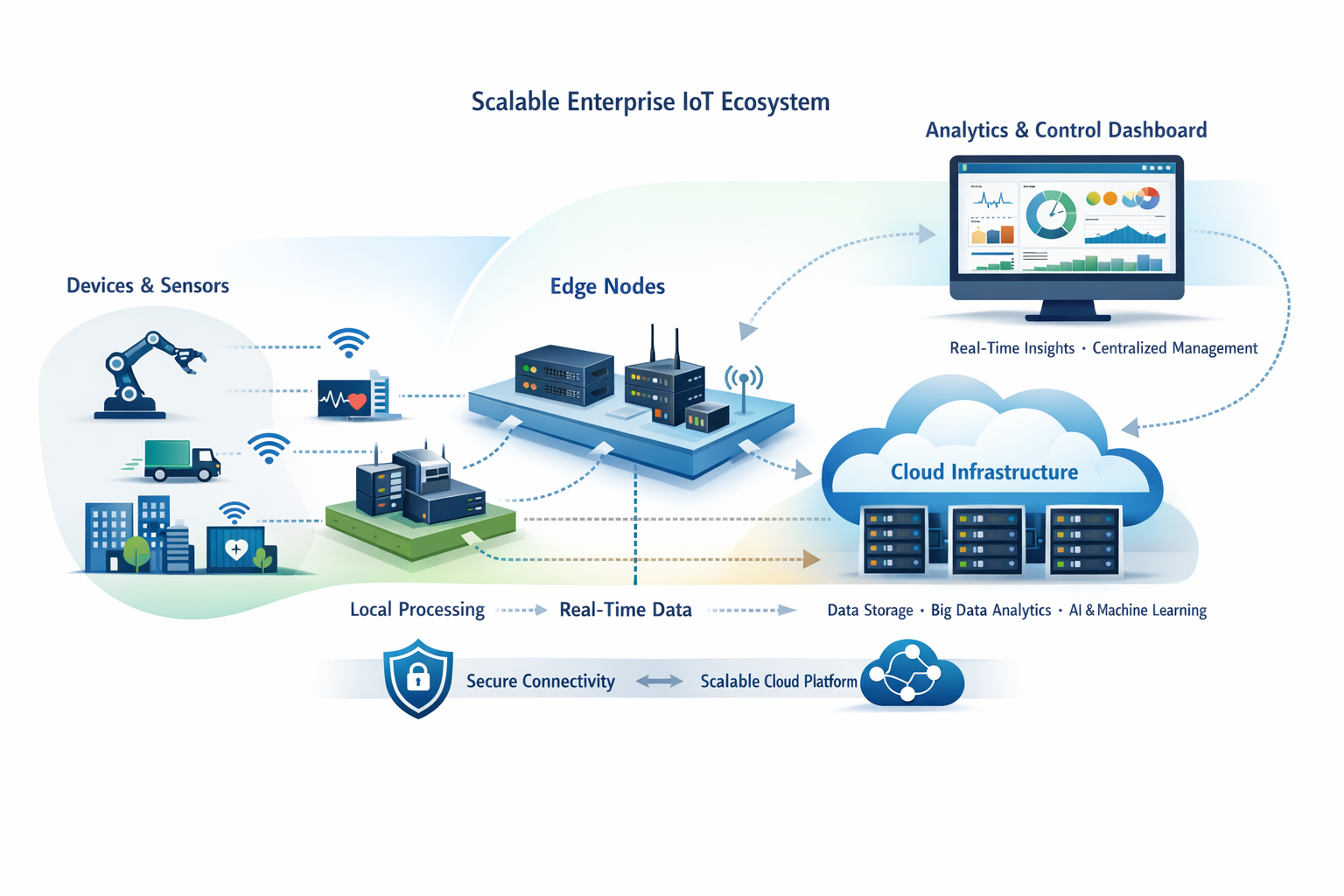
Processing data closer to the source reduces latency, enhances decision speed, and minimizes bandwidth strain. This is particularly critical in manufacturing, healthcare monitoring, and smart logistics .
For a deeper technical breakdown, refer to our detailed guide:
IoT & Edge Computing: The Ultimate Guide to Connected Technology
When edge intelligence integrates with centralized cloud control, enterprises gain precision without sacrificing scalability.
A Story of Scale Done Right
Consider a global manufacturing enterprise struggling with inconsistent machine downtime.
They had sensors installed. Data was collected. But insights were fragmented.
After engaging expert IoT consulting services, they restructured their architecture. Edge devices were standardized. Security layers were reinforced. A unified data dashboard was implemented.
Within 12 months:
- Downtime reduced by 28%
- Predictive maintenance accuracy improved significantly
- Security incidents dropped to near zero
- Operational visibility expanded across all facilities
The transformation was not about devices. It was about structured IoT Solutions built for scale and trust.
Visual Representation of Enterprise IoT Architecture
Conclusion: Enterprise IoT Demands Authority, Not Experimentation
The future of enterprise innovation is deeply connected. However, a connection without control is chaos.
Advanced IoT Solutions built for enterprise scale require strategic design, disciplined execution, and structured governance. IoT consulting firms play a defining role in translating ambition into stable infrastructure.
If your organization plans to scale IoT beyond pilot programs, ask the real question:
Is your architecture built for trust?
Because at enterprise scale, trust is not optional. It is operational currency.